






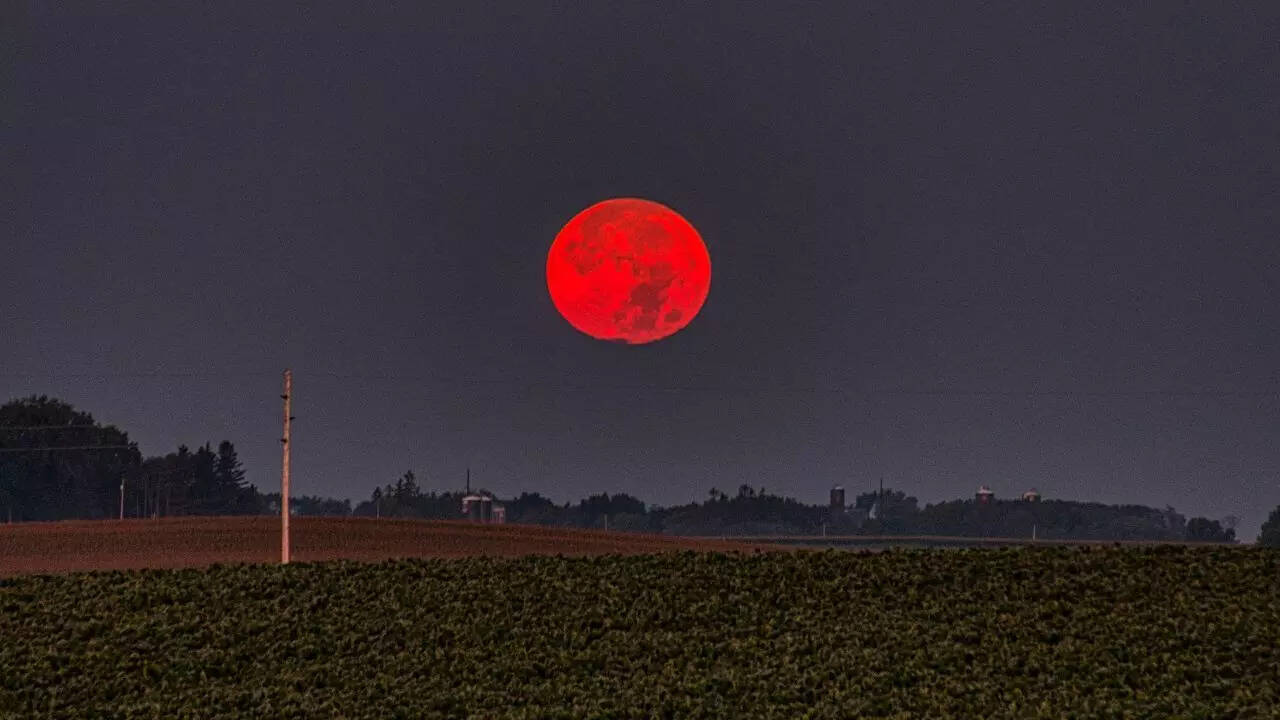
Unveiling the Mystery of the Blood Moon
The appearance of a Blood Moon has captivated humanity for millennia, often stirring a mix of awe and ancient dread. This striking crimson transformation of our lunar companion is a purely scientific phenomenon, rooted in the intricate dance between Earth, Moon, and Sun.
Far from being an ominous sign, a Blood Moon is a breathtaking display of Earth’s atmospheric scattering capabilities. It offers a unique opportunity to witness the subtle interplay of light and shadow on a grand cosmic scale.
A Breathtaking Cosmic Event
A Blood Moon occurs exclusively during a total lunar eclipse, when the Earth is positioned directly between the Sun and the Moon. As our planet casts its shadow upon the Moon, sunlight must first pass through Earth’s atmosphere to reach the lunar surface.
This atmospheric detour is what imbues the Moon with its characteristic reddish hue. It transforms what would otherwise be a dark, obscured Moon into a glowing crimson orb, visible to observers across the nightside of Earth.
More Science Than Superstition
Throughout history, the Blood Moon has been interpreted through various cultural lenses, often associated with prophecies, impending doom, or significant shifts. However, modern astronomy has demystified this celestial event, providing a clear scientific explanation.
Understanding the physics behind this spectacle allows us to appreciate its natural beauty without succumbing to ancient fears. It is a testament to the wonders of our solar system and the physical properties of light.
Earth’s Atmosphere: The Cosmic Filter
The core principle behind the Blood Moon’s color is a process known as Rayleigh scattering. This is the same atmospheric effect that makes our sky appear blue during the day and sunsets appear red or orange.
During a total lunar eclipse, the sunlight that ultimately reaches the Moon is filtered and bent by Earth’s atmosphere. This filtering preferentially removes shorter, bluer wavelengths of light.
Rayleigh Scattering Explained
Rayleigh scattering occurs when electromagnetic radiation, like sunlight, interacts with particles much smaller than its wavelength. In Earth’s atmosphere, these particles are primarily nitrogen and oxygen molecules.
Blue light, with its shorter wavelengths, is scattered more efficiently by these tiny atmospheric particles. This scattering effect is why the blue light is dispersed across the sky, giving it its characteristic color.
The Path of Sunlight
As sunlight enters Earth’s atmosphere, the blue components are scattered away and diffused. The longer, redder wavelengths, however, are less affected by this scattering.
These red and orange wavelengths continue their journey, bending around the edges of our planet. They are then refracted into Earth’s umbra, the darkest part of its shadow, where the Moon resides during an eclipse.
Why Red Light Prevails
The refracted red light then illuminates the lunar surface, causing it to glow with a distinctive coppery or reddish hue. This is the light that has successfully traversed the gauntlet of Earth’s atmosphere.
The intensity and specific shade of red can vary significantly based on the amount of dust, clouds, and other atmospheric conditions present on Earth at the time of the eclipse.
Dispelling Myths and Misconceptions
For centuries, Blood Moons have been shrouded in myth and superstition, frequently linked to prophecies, natural disasters, or dire warnings. These narratives often stem from a lack of scientific understanding of celestial mechanics.
Today, with advanced astronomical knowledge, we can confidently assert that a Blood Moon is a completely natural and predictable astronomical event. It carries no inherent danger or mystical significance.
A Natural Phenomenon
The alignment of the Sun, Earth, and Moon in a precise configuration is a regular occurrence in our solar system. Lunar eclipses, including total ones that produce Blood Moons, happen periodically.
These events are governed by the laws of physics and celestial mechanics, predictable with high accuracy far in advance by astronomers worldwide.
No Danger to Earth
Despite sensationalized claims, a Blood Moon poses absolutely no threat to Earth or its inhabitants. It does not cause earthquakes, tsunamis, or any other natural calamities.
The gravitational forces at play during a lunar eclipse are minimal and have no measurable impact beyond the typical tidal effects already experienced daily.
Observing a Blood Moon
Witnessing a Blood Moon is a profoundly rewarding experience for sky-gazers of all ages. Unlike solar eclipses, which require specialized eye protection, lunar eclipses are perfectly safe to observe directly.
The spectacle unfolds gradually, allowing ample time to appreciate the subtle changes in the Moon’s appearance as it enters and exits Earth’s shadow.
No Special Equipment Needed
You don’t need telescopes or binoculars to enjoy a Blood Moon, though they can enhance the viewing experience, revealing more surface details. Your naked eye is perfectly sufficient to appreciate the stunning color transformation.
A simple pair of binoculars can offer a magnified view, bringing the Moon’s craters and features into sharper relief against its ruddy glow.
Timing and Location
The most critical factors for observation are clear skies and knowing the exact timing of the eclipse for your specific location. Lunar eclipses are visible from anywhere on the night side of Earth where the Moon is above the horizon.
Consult local astronomical societies or reputable online sources for precise eclipse timings, including when the Moon enters and exits the penumbra and umbra, and the period of totality.
Historical and Cultural Significance
Before the advent of modern astronomy, cultures worldwide developed diverse interpretations for lunar eclipses. The sudden darkening and reddening of the Moon often inspired powerful myths and beliefs.
These stories reflect humanity’s innate desire to understand the cosmos and integrate celestial events into their worldview, often attributing them to divine intervention or earthly omens.
From Fear to Fascination
In many ancient civilizations, a Blood Moon was viewed with apprehension, sometimes associated with war, famine, or the death of kings. Rituals were often performed to appease deities or ward off perceived dangers.
As scientific understanding grew, these fears gradually gave way to scientific curiosity and aesthetic appreciation, transforming the Blood Moon into a subject of fascination rather than dread.
Across Different Cultures
The Incas believed a jaguar was attacking the Moon, causing its blood-red appearance. Mesopotamians saw it as an attack on their king, performing rituals to temporarily replace him with a commoner.
Conversely, some cultures viewed it as a symbol of transformation or a powerful spiritual moment, highlighting the vast spectrum of human interpretation for natural phenomena.
The Spectrum of Atmospheric Effects
While the term “Blood Moon” implies a consistent deep red, the actual color can vary significantly from one eclipse to another. This variation is a direct consequence of the ever-changing state of Earth’s atmosphere.
Factors such as volcanic eruptions, dust storms, and even the amount of cloud cover along the limb of the Earth where sunlight is passing can dramatically alter the Moon’s appearance.
Factors Influencing Color
A clean, clear atmosphere allows more red light to pass through, resulting in a bright, coppery-red Moon. However, if Earth’s atmosphere is particularly dusty or contains a lot of aerosols, the Moon might appear a darker, duller red or even a brownish-grey.
The exact path sunlight takes through our atmosphere, influenced by the alignment, also plays a role in the spectrum of colors projected onto the lunar surface.
Volcanic Ash and Dust
Major volcanic eruptions can inject vast quantities of ash and aerosols into the stratosphere. These particles can dramatically increase the scattering of even red light, leading to particularly dark or almost black lunar eclipses.
Historical records of unusually dark eclipses have sometimes been correlated with significant volcanic activity preceding the event, demonstrating Earth’s atmosphere as a dynamic filter.
Why Every Blood Moon is Unique
Each total lunar eclipse, producing a Blood Moon, is a unique astronomical event. The specific shade and brightness of the red glow are never precisely the same, offering a distinctive spectacle every time.
This individuality is due to the subtle variations in Earth’s atmospheric composition and conditions at the precise moment of light refraction.
Variables in Earth’s Atmosphere
The amount of dust, water vapor, clouds, and even smoke from wildfires present in the specific ring of Earth’s atmosphere that sunlight passes through all contribute to the final color. These conditions are rarely identical for any two eclipses.
Even seemingly minor shifts in atmospheric pressure or temperature can influence how light is scattered and refracted, leading to nuanced differences in the Moon’s appearance.
A Photographer’s Dream
For astrophotographers, this variability makes each Blood Moon a unique challenge and opportunity. Capturing the distinct shades of crimson, orange, and even hints of blue along the lunar limb is a prized achievement.
The subtle interplay of light and shadow, combined with Earth’s atmospheric conditions, ensures that no two Blood Moon photographs are ever exactly alike, showcasing its artistic potential.
Future Blood Moon Events
Staying informed about upcoming lunar eclipses allows enthusiasts to plan their viewing experience. These celestial events are well-documented and predicted by astronomical organizations years in advance.
Information on future total lunar eclipses, including visibility maps and exact timings, is readily available from numerous scientific and educational platforms.
Predicting Lunar Eclipses
Astronomers use sophisticated calculations based on orbital mechanics to accurately predict the dates and times of lunar eclipses. These predictions are highly reliable and cover many decades into the future.
These forecasts include details on when the partial and total phases begin and end, as well as the path of visibility across the globe.
Where to Find Information
To learn about the latest trends in astronomy and upcoming celestial events, reliable sources are invaluable. Many scientific institutions and space agencies offer comprehensive guides.
For a deeper dive into the science behind these awe-inspiring events, you can consult an Official Source, providing detailed explanations and historical context.
Embracing the Celestial Dance
The Blood Moon stands as a magnificent testament to the beauty and mechanics of our solar system. It transforms a total lunar eclipse into a visually stunning event, painted by Earth’s own atmospheric artistry.
By understanding the science, we can move beyond ancient fears and appreciate this crimson orb for the spectacular natural wonder it truly is, a reminder of the universe’s endless marvels.
Frequently Asked Questions About Blood Moons
What exactly is a Blood Moon?
A Blood Moon is the common term used to describe the appearance of the Moon during a total lunar eclipse. In this celestial alignment, the Earth passes directly between the Sun and the Moon, casting a shadow on the lunar surface. Instead of disappearing completely, the Moon takes on a striking reddish or coppery hue, leading to its evocative name. This distinctive color is caused by Earth’s atmosphere scattering sunlight, allowing only red wavelengths to reach the Moon.
Why does the Moon turn red during a total lunar eclipse?
The Moon turns red during a total lunar eclipse due to a phenomenon called Rayleigh scattering, which also makes Earth’s sky blue and sunsets red. As sunlight passes through Earth’s atmosphere, shorter, bluer wavelengths of light are scattered away more effectively by atmospheric particles. The longer, redder wavelengths, however, penetrate the atmosphere, are refracted, and then illuminate the Moon within Earth’s shadow. This filtered light bathes the Moon in a crimson glow.
Is a Blood Moon dangerous or a bad omen?
Absolutely not. Despite ancient superstitions and cultural beliefs that sometimes associated Blood Moons with impending doom or danger, modern science confirms that they are purely natural astronomical events. There is no evidence or scientific basis to suggest that a Blood Moon causes any harm to Earth, its inhabitants, or influences human events. It is a predictable and harmless celestial spectacle, observed and understood through scientific principles.
How often do Blood Moons occur?
Blood Moons, or total lunar eclipses, occur periodically, but not every year from every location. On average, there are about two lunar eclipses each year, though not all of them are total. A total lunar eclipse can happen roughly once every one to three years, but the visibility depends on your geographic location. The specific cycle and frequency can vary, with some years having multiple total lunar eclipses and others having none.
Do I need special equipment to view a Blood Moon?
No, special equipment is not required to view a Blood Moon. Unlike solar eclipses, which demand certified protective eyewear, lunar eclipses are completely safe to observe directly with the naked eye. While binoculars or a telescope can offer a magnified view and reveal finer details of the lunar surface and its changing colors, they are not necessary for enjoying the basic spectacle. Just find a dark location with an unobstructed view of the Moon.
What is the difference between a total lunar eclipse and a partial lunar eclipse?
The key difference lies in the extent to which the Moon passes through Earth’s shadow. During a total lunar eclipse, the entire Moon passes into Earth’s umbra, the darkest part of its shadow, resulting in the Blood Moon effect. In contrast, a partial lunar eclipse occurs when only a portion of the Moon enters the umbra. The un-eclipsed part of the Moon remains brightly lit by the Sun, while the part in the umbra may appear dim or slightly reddish.
Can clouds obscure a Blood Moon?
Yes, unfortunately, clouds can significantly obscure or completely hide a Blood Moon. The visibility of any celestial event, including a lunar eclipse, is highly dependent on local weather conditions. If the sky is heavily overcast, the Moon may be partially or entirely hidden from view. Clear skies are essential for the best viewing experience, allowing observers to fully appreciate the Moon’s transformation and the rich reddish hues.
Does the Earth’s atmosphere always cause the Moon to turn red during an eclipse?
Yes, Earth’s atmosphere is always responsible for the Moon turning red during a total lunar eclipse. However, the exact shade and brightness of the red can vary considerably. Factors like the amount of dust, volcanic ash, clouds, and aerosols present in Earth’s atmosphere at the time of the eclipse influence how much sunlight is scattered and how much red light is refracted onto the Moon. A very “dirty” atmosphere can even result in a very dark, dull-red, or brownish Moon.
Are Blood Moons visible from everywhere on Earth?
No, Blood Moons are not visible from everywhere on Earth. A total lunar eclipse, and thus a Blood Moon, can only be seen from any location on Earth where the Moon is above the horizon during the entire duration of the eclipse. This means that roughly half of the Earth experiences the event, while the other half (where it’s daytime or the Moon is below the horizon) does not. Its visibility is determined by your geographical location and the time of the eclipse.
What makes each Blood Moon’s color unique?
Each Blood Moon’s color is unique due to the ever-changing composition and conditions of Earth’s atmosphere. The amount of dust, volcanic ash, water vapor, and even cloud cover in the specific part of the atmosphere that sunlight passes through varies from eclipse to eclipse. These atmospheric variables act as a filter, determining the exact wavelengths and intensity of light that reach the Moon, resulting in a slightly different shade of red or orange for every total lunar eclipse.
SEO Keywords
Blood Moon, Lunar Eclipse, Total Lunar Eclipse, Red Moon, Earth’s Atmosphere, Rayleigh Scattering, Moon Turns Red, Celestial Event, Astronomical Phenomenon, Space Science, Moon Photography, Eclipse Viewing, Lunar Cycle, Skygazing, Total Eclipse Explained
Source: Times of India