






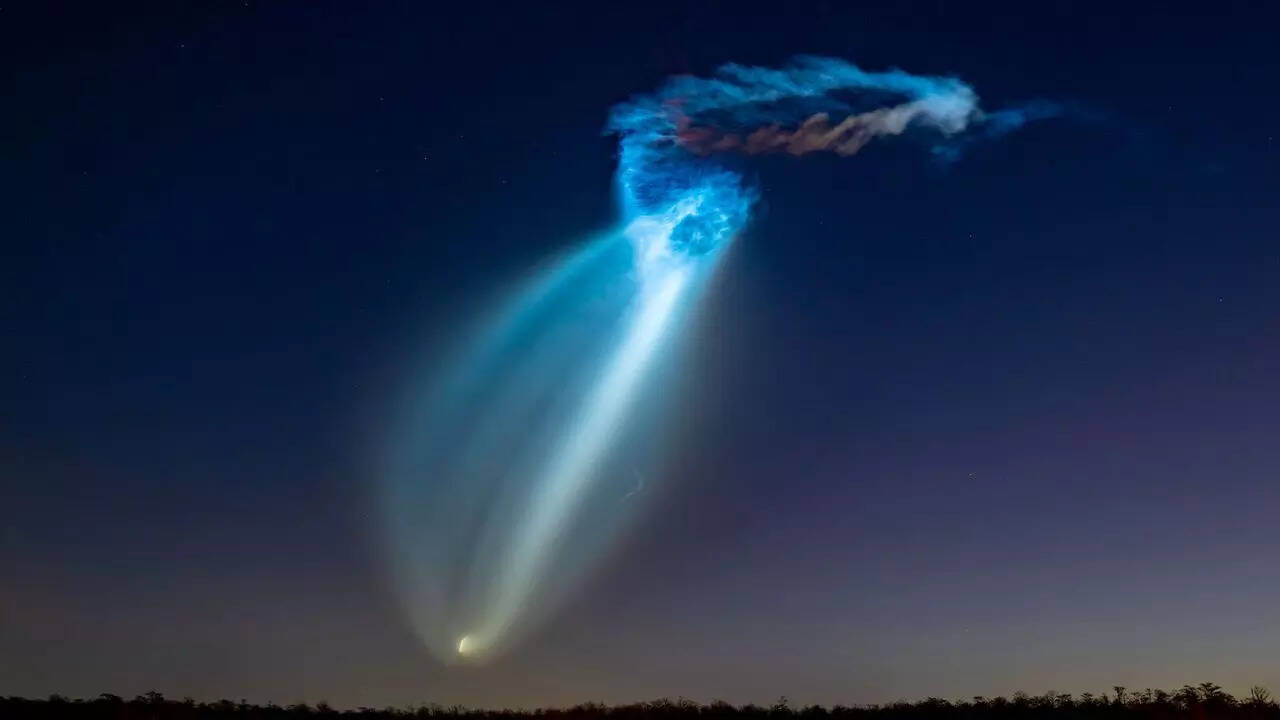
The night sky over Florida recently offered a breathtaking spectacle, captivating observers with an otherworldly display. What appeared to be a shimmering “space jellyfish” emerged during a routine rocket launch, sparking widespread wonder and discussion.
This mesmerizing event was captured by numerous cameras and eyewitnesses, quickly becoming a viral sensation across social media platforms. It highlighted the unexpected beauty that can arise from humanity’s ambitious ventures into space.
The Celestial Spectacle Unveiled
What Observers Saw
As the rocket ascended through the twilight sky, its exhaust plume began to interact with the high-altitude sunlight. This created a luminous, bell-shaped cloud, eerily resembling a cosmic jellyfish floating gracefully above the horizon.
The core of the plume glowed brightly, while tendrils of exhaust expanded outwards, catching the last rays of the sun. This juxtaposition of light and shadow against the darkening sky formed a truly unforgettable image.
Witness Accounts and Public Reaction
Residents across Florida, from Orlando to Miami, reported seeing the magnificent sight, often sharing their experiences in real-time. Many described it as an awe-inspiring, almost spiritual moment, unlike anything they had witnessed before.
Social media platforms buzzed with photos, videos, and exclamations of amazement, with terms like “space jellyfish” and “celestial marvel” trending instantly. The collective excitement underscored the public’s enduring fascination with space exploration and its visual byproducts.
The Launch Details Behind the Glow
The spectacular display was a byproduct of a routine mission to deploy 29 advanced internet satellites. This particular launch was part of a broader initiative aimed at expanding global connectivity, especially in remote and underserved regions.
Such missions are becoming increasingly common, but the atmospheric conditions aligned perfectly on this occasion to create such a vivid visual effect. The timing of the launch, just after sunset, was crucial for the phenomenon to manifest so dramatically.
Understanding the “Space Jellyfish”
Scientific Explanation of the Phenomenon
The “space jellyfish” effect is a well-understood atmospheric phenomenon, though rarely seen with such clarity. It occurs when a rocket’s exhaust plume, composed primarily of water vapor and carbon dioxide, expands at very high altitudes.
As the plume expands into the near-vacuum of space, it diffuses and interacts with sunlight that is no longer visible from the ground. This illumination of the high-altitude exhaust creates the glowing, cloud-like structures seen by observers.
The Role of Atmospheric Conditions
Optimal conditions for this display include a twilight launch, where the ground is dark but the rocket’s high-altitude trajectory is still bathed in sunlight. The sun’s rays reflect off the expanding plume, making it visible against the dark sky.
Factors like humidity, air pressure, and the specific trajectory of the rocket also contribute to the plume’s shape and visibility. The unique combination of these elements on the day of the launch produced the particularly striking “jellyfish” form.
Previous Occurrences and Similar Sights
While this particular “space jellyfish” was exceptionally vivid, similar phenomena have been observed during other rocket launches. These luminous plumes have sometimes been mistaken for UFOs due to their unusual appearance and rapid movement across the sky.
The “twilight phenomenon” or “noctilucent cloud effect” are terms often used to describe these events. Each launch offers a unique set of variables, leading to varied but equally stunning visual outcomes for sky gazers.
The Mission: Connecting the Globe
Starlink’s Purpose and Vision
The 29 satellites deployed during this mission are crucial components of a vast constellation designed to deliver high-speed, low-latency internet globally. This ambitious project aims to bridge the digital divide, connecting communities worldwide.
The vision is to provide reliable internet access to areas where traditional infrastructure is challenging or impossible to implement. This includes remote rural areas, maritime vessels, and regions affected by natural disasters.
How the Satellites Work and Are Deployed
Each satellite is relatively small but packed with advanced technology, including phased-array antennas and solar panels for power. They orbit Earth at a relatively low altitude, allowing for quick signal transmission and minimal latency.
During deployment, the satellites are carefully released from the rocket’s payload fairing, often in batches. They then use their onboard propulsion systems to maneuver into their precise operational orbits, gradually forming the orbital constellation.
Impact on Global Internet Access
The ongoing deployment of these satellites is revolutionizing internet access for millions, particularly those previously underserved. It offers a viable alternative to traditional broadband, which can be expensive or unavailable in many parts of the world.
Improved global connectivity has far-reaching implications, from enhancing educational opportunities to facilitating emergency communications and supporting economic development. The impact extends to fostering greater digital inclusion across continents.
The Awe and Wonder of Space Exploration
Inspiring the Next Generation
Such spectacular celestial events serve as powerful reminders of humanity’s incredible technological capabilities and our enduring quest for discovery. They inspire children and adults alike to look up, ponder, and dream about the possibilities of space.
The visual drama of a rocket launch, especially when it produces a phenomenon like the “space jellyfish,” can ignite curiosity in STEM fields. It encourages aspiring scientists, engineers, and astronauts to pursue their passions.
The Blend of Science and Art
Rocket launches are not merely feats of engineering; they are also profound visual events that blend scientific precision with natural beauty. The “space jellyfish” stands as a testament to this unique fusion, showcasing physics in an artistic light.
This blend appeals to both the logical and creative aspects of human understanding, demonstrating that scientific endeavors can yield unexpected moments of aesthetic wonder. It turns the vastness of space into a canvas for extraordinary displays.
Future Implications for Skywatchers
As the frequency of rocket launches continues to increase, driven by commercial and scientific endeavors, such phenomena may become more common. This offers new opportunities for skywatchers and citizen scientists to observe and document these unique events.
With more launches comes a greater chance for the perfect atmospheric conditions to align, transforming routine deployments into widespread public spectacles. The evolving landscape of space travel promises an ever more dynamic night sky for us all.
Looking Ahead: The Evolving Sky
Increased Space Traffic and Observation
The current era marks an unprecedented increase in orbital launches, with multiple missions occurring each week from various spaceports globally. This surge in activity means the opportunities to witness such atmospheric effects are also growing.
Observing these events requires vigilance and awareness of upcoming launch schedules. Dedicated enthusiasts often track these launches, hoping to catch a glimpse of the next celestial marvel.
Tips for Observing Celestial Events
For those hoping to witness future rocket-induced phenomena, preparation is key. Checking launch schedules, understanding launch trajectories, and finding clear viewing spots away from light pollution significantly improve chances of success.
Using binoculars or a telescope can enhance the view, but often these events are best appreciated with the naked eye due to their expansive nature. Keeping an eye on weather forecasts is also essential for optimal viewing conditions.
Staying Informed on latest trends in Space and Technology
The field of space exploration is constantly evolving, with new missions, technologies, and discoveries emerging regularly. Staying informed helps enthusiasts understand the context behind such visual phenomena and the broader advancements shaping our future.
From new propulsion systems to advanced satellite capabilities, the pace of innovation is rapid. Keeping up with these developments ensures a deeper appreciation of both the science and the spectacles they produce. For an Official Source on the ‘space jellyfish’ event, you can refer to this external article.
Conclusion
The “space jellyfish” witnessed over Florida was a beautiful convergence of advanced engineering and atmospheric physics. It captivated a wide audience, highlighting the poetic beauty inherent in humanity’s pursuit of the stars.
Such events remind us that even routine scientific endeavors can yield extraordinary moments of public wonder and inspiration. As we continue to push the boundaries of space exploration, our skies are sure to hold many more dazzling surprises.
Frequently Asked Questions (FAQs)
1. What exactly is the “space jellyfish” effect?
The “space jellyfish” effect is an optical phenomenon caused by sunlight illuminating the exhaust plume of a rocket at very high altitudes. It occurs when the rocket’s trajectory carries it into sunlight while the observer on the ground is in twilight or darkness, making the expanded plume glow against the darker sky.
2. Why did it look like a “jellyfish”?
The distinct “jellyfish” shape is a result of the exhaust gases expanding rapidly in the near-vacuum of space at high altitudes. The initial dense plume forms the “bell,” while residual exhaust gases and their interaction with upper atmospheric layers create the “tentacles” as they dissipate.
3. Was this a rare event?
While rocket launches are common, the conditions required for such a vivid and widely observed “space jellyfish” are relatively specific. Factors like the precise launch time (twilight), rocket trajectory, atmospheric conditions, and clear skies must align perfectly, making such a prominent display somewhat rare.
4. What type of rocket was involved in this launch?
The phenomenon was observed during a launch involving a Falcon 9 rocket, which is known for its reusable first stage and its role in deploying numerous satellite constellations. This particular mission carried 29 Starlink internet satellites into orbit.
5. What was the purpose of the mission that created this effect?
The mission’s primary purpose was to deploy a batch of 29 Starlink satellites, which are part of a growing constellation providing broadband internet access globally. These satellites aim to deliver high-speed internet to remote and underserved areas worldwide.
6. Can this effect be seen from anywhere?
No, the “space jellyfish” effect is typically visible only from specific regions along the rocket’s launch trajectory, within several hundred miles of the launch site. The visibility depends on the observer’s position relative to the rocket, the sun’s angle, and local weather conditions.
7. Is the “space jellyfish” dangerous or harmful?
The “space jellyfish” effect itself is entirely harmless. It is purely an optical phenomenon caused by the interaction of sunlight with benign rocket exhaust gases. There is no danger to observers on the ground from this visual display.
8. How long does the “space jellyfish” effect last?
The duration of the effect varies but usually lasts for several minutes, typically between 2 to 10 minutes, as the rocket ascends and the plume expands and then gradually dissipates or moves out of the ideal lighting conditions. The most vivid phase is usually brief.
9. Are there other similar atmospheric phenomena caused by rockets?
Yes, other phenomena like “twilight phenomena,” “noctilucent clouds,” or “rocket clouds” can occur, varying in appearance. These are all related to rocket exhaust interacting with high-altitude atmospheric conditions and sunlight, creating unique visual effects against the sky.
10. How can I increase my chances of seeing a similar phenomenon?
To increase your chances, monitor official launch schedules from space agencies or private companies. Position yourself in an area with clear skies and minimal light pollution. Ideal viewing occurs during twilight launches (shortly after sunset or before sunrise) when the rocket ascends into sunlight.
15 SEO Keywords:
- Space jellyfish Florida
- Rocket launch phenomenon
- Falcon 9 Starlink
- Celestial spectacle
- Atmospheric optics
- Twilight phenomenon
- Space exploration news
- Starlink satellites
- Florida sky observation
- Rocket exhaust plume
- Global internet connectivity
- UFO rocket effect
- Astronomy events Florida
- Space beauty effects
- Rocket launch viewing
Source: Times of India