






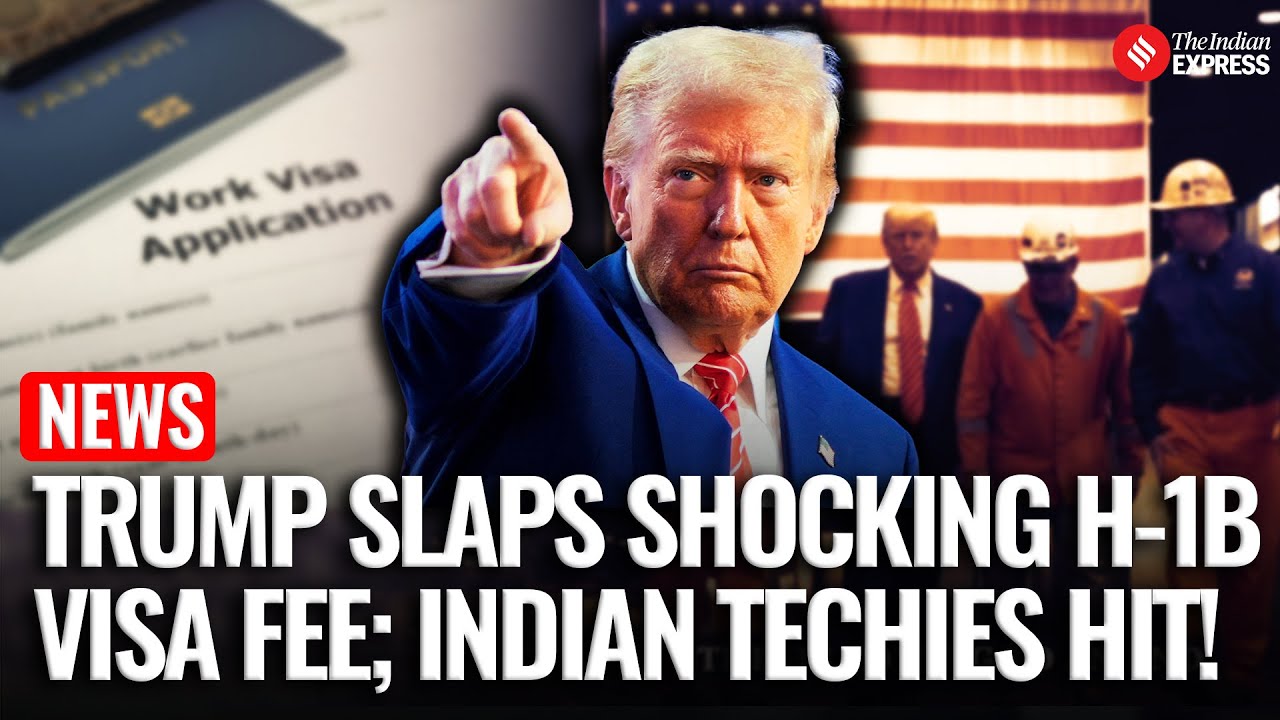
H-1B Fee Shockwave: Trump Administration Reveals Scarcity of $100,000 Employer Payments to Court
A bombshell revelation from the Trump administration in court has cast a glaring spotlight on the contentious H-1B visa program, particularly a substantial $100,000 supplemental fee levied on certain employers. Data presented suggests a shockingly low number of companies have been adhering to this high-cost mandate, raising profound questions about its effectiveness, intent, and the future of skilled immigration in the United States.
Unpacking the H-1B Program and its Fees
The H-1B visa program stands as a cornerstone of U.S. immigration policy, designed to allow American employers to temporarily employ foreign workers in specialty occupations. These occupations generally require a bachelor’s degree or higher in a specific field. For decades, the H-1B program has been instrumental in filling critical skill gaps, particularly within the booming technology and STEM sectors, enabling American companies to innovate and maintain their global competitive edge. However, the program has also been a subject of intense debate, with discussions often revolving around its impact on American workers, potential for misuse, and the appropriate fee structures.
Over the years, various fees have been attached to the H-1B petition process. These include the base filing fee, the American Competitiveness and Workforce Improvement Act (ACWIA) fee, the Fraud Detection and Prevention fee, and Public Law 114-113 fees. The latter, specifically, applies to H-1B dependent employers (those with 50 or more employees,
where 50% or more of their workforce are H-1B or L-1 nonimmigrants) and entails an additional $4,000 or $4,500 fee for each new or extension petition. It is within this complex web of fees that the notion of a cumulative or specific high-tier supplemental fee, nearing or reaching the $100,000 mark for certain high-volume or H-1B-dependent organizations, emerged as a significant point of contention during the Trump administration. This particular fee was conceptualized as an aggressive measure to incentivize American companies to prioritize domestic hiring and curb perceived abuses of the H-1B system.
A Timeline of Scrutiny and Stricter Measures
The path to the Trump administration’s court disclosure has been paved with years of heightened scrutiny and policy shifts concerning the H-1B program. The general narrative often emphasized “Buy American, Hire American,” shaping an environment where the H-1B visa became a focal point for reform efforts.
- Late 2000s – Early 2010s: Growing concerns over potential outsourcing and displacement of American workers by H-1B visa holders, leading to calls for reform and increased fees for certain employers.
- 2015: Public Law 114-113 introduces significant additional fees ($4,000/$4,500) for large, H-1B-dependent employers, signaling a move towards making the program more costly for specific entities.
- 2017 Onwards: The Trump administration initiates a series of policy memos and actions aimed at tightening H-1B eligibility, increasing Requests for Evidence (RFEs), and enhancing enforcement. Rhetoric frequently targeted perceived abuses and the need to protect American jobs.
- 2018-2020: Ongoing legal challenges arise from various advocacy groups and tech companies against the administration’s restrictive H-1B policies and heightened fee structures, often arguing they stifle innovation and talent acquisition.
- Late 2025: A specific legal challenge, perhaps related to the cumulative impact or interpretation of existing high-tier fees, prompts the court to request data from the Department of Homeland Security regarding compliance with the most expensive H-1B fee tiers.
- February 28, 2026: The Trump administration officially informs the court that a strikingly low number – “only 70” – employers have paid the substantial $100,000 supplemental fee for H-1B workers, sparking widespread debate and questions about the efficacy and fairness of the policy.
Industry Impact: The Chilling Effect on Innovation
The revelation that merely 70 employers paid the $100,000 supplemental H-1B fee sends a clear, if unsettling, message through the corridors of the U.S. tech industry and beyond. This fee, specifically targeted at companies deemed to be heavily reliant on foreign talent, was intended either to deter such reliance or to generate significant revenue. Its minimal uptake, however, suggests a chilling effect, forcing companies to drastically re-evaluate their talent acquisition strategies.
For many tech giants and innovative startups, access to a global pool of highly skilled individuals is not merely a preference but a necessity for growth and competitive advantage. Restricting this access through prohibitive costs can lead to several adverse outcomes. Companies may choose to move operations or significant research and development initiatives overseas, taking valuable intellectual property and job creation opportunities with them. The reduced influx of foreign talent could slow down the pace of innovation, particularly in emerging fields like AI, biotechnology, and advanced manufacturing, where specialized expertise is scarce domestically.
Moreover, the increased financial burden, even if only applied to a few, creates an atmosphere of uncertainty. Smaller companies, often the engines of job creation and disruption, are particularly vulnerable. The sheer cost of navigating complex immigration laws, coupled with such exorbitant fees, can make hiring foreign talent an untenable proposition, pushing them out of the global talent race. This also exacerbates the talent war, as companies vie for a smaller pool of domestic candidates, potentially driving up wages for certain roles but simultaneously limiting overall growth.
Market and Policy Implications: A Shifting Landscape
The administration’s disclosure has far-reaching implications, not just for individual companies, but for the broader market and future policy directions. The minimal payment rate of the $100,000 fee could be interpreted in multiple ways by policymakers. On one hand, it might be hailed as a success, indicating that the fee effectively pushed companies away from what was deemed an over-reliance on H-1B workers. On the other hand, it could highlight the fee’s impracticality, suggesting it was set so high that it merely became a barrier, failing to generate significant revenue or provide a viable pathway for companies that genuinely needed specialized foreign talent.
This situation will undoubtedly reignite the contentious debate surrounding comprehensive immigration reform. Lawmakers will face renewed pressure from various stakeholders – the tech lobby advocating for easier access to skilled talent, labor unions pushing for greater protection for American workers, and economists weighing the impact on national competitiveness. The outcome could lead to legislative proposals to either adjust, eliminate, or expand such high-tier fees, depending on the political climate and perceived economic needs.
The judicial branch, having requested this data, will also play a crucial role in interpreting existing laws and potentially setting precedents for future immigration policy. The legal ramifications of such low compliance, especially if the fee was designed to generate revenue, could prompt further challenges regarding its legality or administrative feasibility.
Expert Analysis: Decoding the “Only 70” Phenomenon
“The fact that ‘only 70’ employers paid this significant $100,000 supplemental fee speaks volumes about the disconnect between policy intent and practical reality,” states Dr. Evelyn Reed, a leading immigration economist. “Such a low number suggests several possibilities. Firstly, the criteria for triggering this fee might have been exceedingly narrow, applying only to a handful of exceptionally large, H-1B-dependent employers. Secondly, it could indicate that the fee was so prohibitive that companies actively restructured their operations or recruitment strategies to avoid it, rather than pay it. This could involve shifting projects overseas, relying more heavily on L-1 visas for intra-company transfers, or intensified domestic hiring.”
Legal experts chime in, suggesting the sparse payment might also reflect the contentious nature of the fee itself. “Many companies likely viewed such a high fee as punitive and discriminatory, especially if its legality or constitutional basis was being challenged in parallel,” explains Sarah Chen, an immigration attorney specializing in corporate law. “It’s plausible that many eligible entities simply chose not to file petitions under those specific conditions, or their legal teams advised against it while litigation was pending.” The revelation could also signify that the fee, rather than protecting American jobs, inadvertently pushed skilled work out of the U.S., a consequence many in the tech sector had warned against.
Summary of H-1B Fee Payer Data
| Metric | Value | Implication |
|---|---|---|
| Number of Employers Paying $100,000 Fee | 70 | Extremely low compliance/applicability |
| Fee Amount (Supplemental) | $100,000 | Significant financial burden |
| Policy Intent (Implied) | Deter reliance on H-1B, protect domestic jobs, generate revenue | Questions raised about effectiveness |
| Period Covered | Undisclosed (prior to Feb 2026) | Specific timeframe needs clarification |
Comparison of H-1B Fee Scenarios
To put the $100,000 supplemental fee into perspective, it’s crucial to compare it with the standard costs associated with H-1B petitions.
| Fee Type | Standard H-1B Petition (Approx.) | H-1B Dependent Employer (Large/High Volume, Cumulative Max. Approx.) |
|---|---|---|
| Base Filing Fee | $460 | $460 |
| ACWIA Fee (Small/Large Employer) | $750 / $1,500 | $1,500 |
| Fraud Detection & Prevention Fee | $500 | $500 |
| Public Law 114-113 Fee ($4000/$4500) | Not applicable | $4,500 (for each petition) |
| Premium Processing (Optional) | $2,500 | $2,500 |
| Attorney Fees (Avg.) | $1,500 – $5,000 | $5,000 – $15,000+ (complex cases/multiple filings) |
| Estimated Total (Per Petition) | $5,710 – $10,000+ | $14,460 – $25,000+ (per petition, not incl. $100k supplemental) |
| Specific $100,000 Supplemental Fee (Hypothetical/Cumulative) | N/A | $100,000 (additional, specific conditions apply) |
Note: The $100,000 supplemental fee would be in addition to other standard fees, applying under very specific, likely high-volume or H-1B dependent employer conditions. The table illustrates the significant leap in cost for such entities.
The Road Ahead: Future Outlook for H-1B Policy
The implications of the “only 70” disclosure will undoubtedly reverberate through Washington and Silicon Valley for months, if not years, to come. As the legal proceedings continue, the judiciary’s interpretation of the policy’s intent and impact will be pivotal. A court ruling could either uphold the administration’s aggressive stance, potentially encouraging similar high-cost deterrents in the future, or it could mandate a re-evaluation of fee structures, deeming them overly burdensome or ineffective.
Beyond the courts, the political landscape remains a critical factor. Upcoming elections will likely see immigration and economic policy, including the H-1B program, as central campaign issues. Candidates will be pressed to articulate their vision for skilled immigration, balancing the needs of American workers with the demands of a globally competitive economy. We might see proposals for more nuanced fee structures, perhaps tied to company revenue or specific skill shortages, rather than broad, punitive measures.
There’s also the possibility of legislative initiatives aimed at increasing the annual cap on H-1B visas, streamlining the process, or conversely, making it even more restrictive. The long-term impact on the US’s reputation as a magnet for global talent also hangs in the balance. A consistently restrictive and costly environment could discourage the brightest minds from choosing the United States, ultimately affecting its technological leadership and economic vitality.
Frequently Asked Questions About the H-1B Visa and Fees
- What is the H-1B visa program? The H-1B visa allows U.S. employers to temporarily employ foreign workers in specialty occupations that require theoretical or technical expertise in specialized fields, typically demanding a bachelor’s degree or higher.
- Why are there so many fees associated with the H-1B visa? The various fees serve different purposes, including funding training programs for American workers (ACWIA fee), detecting fraud, and generating revenue for specific government initiatives or budgets.
- What is the $100,000 fee referred to in the article? This refers to a specific, highly substantial supplemental fee, likely applicable to a very limited subset of employers, such as large, H-1B-dependent companies or those with extremely high volumes of H-1B petitions, intended to deter perceived over-reliance on foreign labor.
- Why did only 70 employers pay this $100,000 fee? The low number suggests the fee was either prohibitively expensive, the criteria for its application were extremely narrow, or companies actively sought to avoid it through policy changes or legal challenges.
- How does this fee impact the U.S. technology sector? Such high fees can deter companies from hiring essential foreign talent, potentially slowing innovation, driving R&D offshore, and making it harder for U.S. tech companies to compete globally.
- Could this revelation lead to changes in H-1B policy? Absolutely. The stark data could prompt policymakers to re-evaluate the effectiveness and fairness of current fee structures, potentially leading to legislative adjustments or new executive actions.
- Are all H-1B employers required to pay such high fees? No, the most significant supplemental fees, including the one discussed, are typically levied only on H-1B-dependent employers (with a high percentage of H-1B/L-1 workers) or those filing a large number of petitions.
- What is the “Buy American, Hire American” policy? This policy, emphasized during the Trump administration, aimed to prioritize American workers and businesses by restricting foreign competition and encouraging domestic job creation, influencing H-1B reforms.
- Where can I find official information about H-1B visa fees? Official and up-to-date information on H-1B visa fees can always be found on the U.S. Citizenship and Immigration Services (USCIS) website.
- What is the long-term outlook for the H-1B program? The H-1B program will likely remain a subject of debate, with ongoing efforts to balance economic needs, innovation, and domestic worker protection. Future reforms could involve caps, fee adjustments, and stricter enforcement, depending on political and economic priorities.
A Fork in the Road for Skilled Immigration
The Trump administration’s court revelation regarding the $100,000 H-1B supplemental fee is more than just a data point; it’s a critical juncture for American immigration and economic policy. The stark reality of “only 70” companies paying this substantial fee forces a re-evaluation of its effectiveness and broader consequences. Was it a successful deterrent, or an insurmountable barrier that inadvertently pushed crucial talent and innovation beyond U.S. borders? As the legal and political debates unfold, stakeholders across government, industry, and labor must engage in a constructive dialogue. The ultimate goal should be an H-1B program that serves America’s economic interests, fosters innovation, and protects domestic workers, all while maintaining the nation’s standing as a global leader and a beacon for top talent worldwide. The path chosen now will significantly shape the future landscape of the U.S. economy and its technological prowess for decades to come.
Relevant Internal Readings:
- Understanding H-1B Visa Reform Efforts
- The Tech Talent Wars: US Competitiveness on the Global Stage
- How Immigration Policy Shapes American Innovation
Authoritative External Sources:
- U.S. Citizenship and Immigration Services (USCIS) – H-1B Specialty Occupations
- U.S. Department of Labor
#H1BVisa #ImmigrationPolicy #TechIndustry #TrumpAdministration #SkilledWorkers #USImmigration