






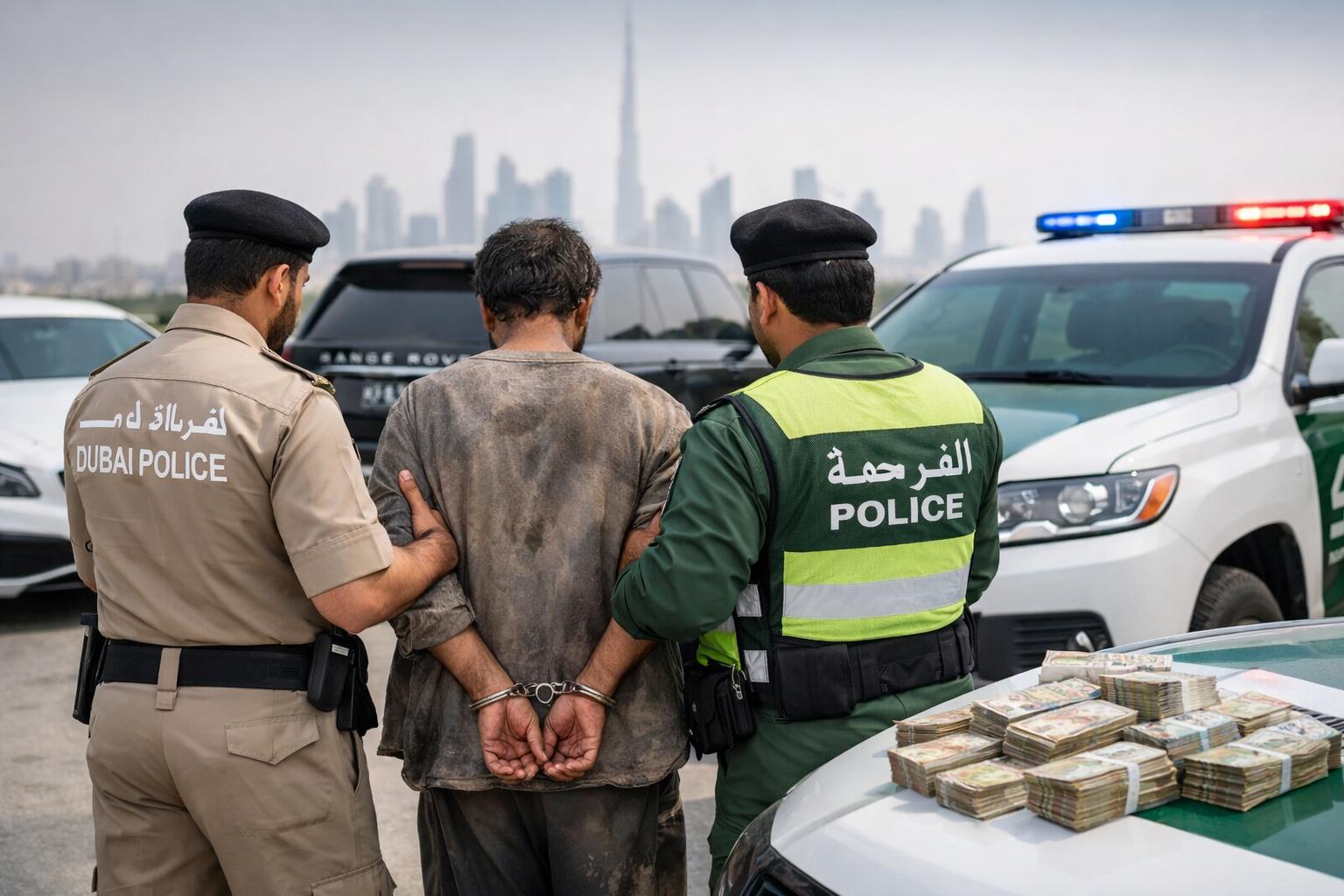
Dubai’s Elite Beggar Bust: Luxury Cars Uncover Shocking Underworld Amid Ramadan Crackdown
In a stunning revelation that has sent shockwaves through the glittering metropolis of Dubai, authorities have apprehended a beggar found in possession of not one, but three luxury vehicles. This extraordinary arrest, made amidst the sacred month of Ramadan during an intensified anti-begging campaign, peels back the veneer of perceived poverty to expose a sophisticated, illicit enterprise thriving within one of the world’s wealthiest cities.
The Unseen Underbelly: A Glimpse into Dubai’s Anti-Begging Efforts
Dubai, a global hub renowned for its futuristic skyline, extravagant lifestyles, and strict law enforcement, maintains a zero-tolerance policy against begging. The emirate views begging not merely as a social issue but as a threat to its meticulously curated image of order, prosperity, and security. Year after year, particularly during religious festivals like Ramadan, when charitable sentiments are heightened, the Dubai Police launch extensive campaigns to curb this phenomenon. These crackdowns aim to protect the public from exploitation and prevent organized groups from profiting off deception.
For years, officials have warned residents and visitors against giving money to beggars, emphasizing that many are part of organized rackets, some even entering the country on tourist visas specifically to exploit the generosity of the community. The narrative has always been that these individuals are often not genuinely needy but are rather operatives in a lucrative, clandestine business. Yet, even with these persistent warnings, the scale of the operations, as highlighted by this recent arrest, continues to astonish.
Background Context: The Persistent Challenge of Begging in a Wealthy Emirate
Despite its immense wealth, Dubai, like many rapidly developing urban centers, faces complex social challenges. The influx of diverse populations, coupled with varying economic circumstances, can sometimes create environments ripe for illicit activities. Begging, while seemingly minor, represents a significant concern for the authorities, who argue it poses risks beyond simple panhandling. It can be linked to human trafficking, illegal residency, and organized crime, undermining the city’s commitment to safety and stability.
The Ramadan period traditionally sees a surge in begging activities. The spiritual significance of giving during this holy month makes the population more susceptible to requests for charity. This understanding fuels the perpetrators, who strategically leverage cultural and religious practices for financial gain. The Dubai Police, therefore, double down on their efforts during this time, employing advanced surveillance techniques and increased patrols to identify and apprehend those engaged in begging.
The Shocking Discovery: A Beggar with a Fleet of Luxury
The recent arrest serves as a stark illustration of the hidden wealth accumulated through such illicit means. The individual, whose identity has not been publicly released, was apprehended as part of the ongoing anti-begging crackdown. What made this particular case extraordinary was the subsequent discovery:
Timeline of Events: Unraveling the Deception
- Early Ramadan Crackdown: Dubai Police initiated their annual intensified anti-begging campaign as the holy month of Ramadan commenced, deploying plainclothes officers and surveillance.
- Identification and Surveillance: The individual, an apparent beggar, was identified through routine patrols and intelligence gathering, attracting attention due to suspicious patterns.
- The Arrest: Police apprehended the suspect while allegedly engaged in begging activities in a high-traffic area known for its charitable residents.
- Luxury Unveiled: During the subsequent investigation, authorities uncovered that the individual owned not one, but three high-end luxury vehicles, meticulously concealed from public view.
- Investigation Underway: The suspect was taken into custody, and a full investigation was launched to determine the extent of their network, the origins of their wealth, and potential links to larger criminal organizations.
This incident is not isolated. In previous years, similar arrests have revealed beggars earning tens of thousands of dirhams monthly. However, the ownership of multiple luxury cars marks a significant escalation in the audacity and financial scale of these operations, pushing the boundaries of public understanding and law enforcement efforts.
Industry Impact: Repercussions for Dubai’s Image and Tourism
Dubai has painstakingly cultivated an international image of luxury, innovation, and impeccable safety. News of a beggar possessing luxury cars, while highlighting effective policing, simultaneously exposes a darker facet that challenges this pristine perception. For the tourism industry, a cornerstone of Dubai’s economy, such revelations can be a double-edged sword.
On one hand, the swift police action reinforces Dubai’s reputation for strict law enforcement and commitment to maintaining order, which can be reassuring to visitors. On the other hand, the very existence of such sophisticated begging operations, capable of generating immense illicit wealth, might raise questions among some about underlying social issues or vulnerabilities within the system. Tour operators and hospitality providers often emphasize Dubai’s safety and cleanliness; incidents like these necessitate a renewed focus on communication to reassure potential tourists that these are isolated incidents swiftly dealt with.
Market and Policy Implications: Strengthening the Resolve
This high-profile arrest is expected to trigger a review and potential tightening of existing anti-begging policies and enforcement strategies. Authorities may intensify checks on individuals entering the country, particularly those on short-term visas, and enhance intelligence-sharing between departments to detect organized begging rings more effectively. There could be a push for:
- Enhanced Surveillance: More sophisticated CCTV and AI-driven monitoring in public spaces.
- Public Awareness Campaigns: Renewed efforts to educate residents and tourists about the organized nature of begging and legitimate channels for charity.
- Inter-Agency Cooperation: Stronger collaboration between police, immigration, and social welfare departments to address both criminal and humanitarian aspects.
- Legal Revisions: Potential for harsher penalties for those caught engaging in organized begging or exploiting others.
The incident also sheds light on the economic disparities that can exist even within affluent societies, driving some individuals into illicit activities, or making them vulnerable to exploitation by criminal syndicates.
Expert-Style Analysis: Decoding the Psychology and Economics of Organized Begging
From an expert perspective, the case of the luxury car-owning beggar is a complex mosaic of human behavior, economic incentives, and systemic vulnerabilities. Dr. Aisha Al-Mansoori, a regional sociologist specializing in urban crime, notes, “Organized begging leverages powerful human emotions – empathy, religious obligation, and a desire to help – against individuals. It’s a low-risk, high-reward enterprise for its orchestrators, especially in affluent areas where the chances of receiving significant donations are higher.”
The economics are compelling. With hundreds, sometimes thousands, of daily interactions, even small donations can quickly accumulate. When multiplied across multiple individuals working for a syndicate, the illicit income becomes substantial enough to afford luxury assets. This is not mere survival begging; it is a meticulously planned criminal operation. The individuals performing the begging act might themselves be exploited, trapped in cycles of debt or coercion, making the problem multifaceted for law enforcement.
Furthermore, the anonymity of large cities and the transient nature of many residents and visitors provide an ideal environment for such operations to flourish. Detecting and dismantling these networks requires not just reactive arrests but proactive intelligence gathering, understanding financial flows, and international cooperation to trace the origins of these syndicates.
Future Outlook: Towards a Begging-Free Dubai
The path forward for Dubai involves a multi-pronged approach that balances stringent enforcement with social welfare initiatives. While the immediate response will undoubtedly be increased police presence and arrests, a sustainable solution requires looking beyond immediate crackdowns.
Authorities may intensify efforts to identify the masterminds behind these rings, aiming to dismantle them from the top down rather than just apprehending street-level operators. Collaboration with international law enforcement agencies could become crucial, as many of these networks operate across borders. Furthermore, promoting legitimate charitable organizations and educating the public on how to donate responsibly can channel goodwill towards genuine causes, thereby starving illicit begging rings of their revenue.
Dubai’s vision is to be a city where prosperity is widely shared and social safety nets are robust. Incidents like these, while challenging, can serve as catalysts for further refining strategies to protect both its residents and its esteemed global reputation.
Comparative Overview: Begging Penalties in Selected Regions
| Region | Typical Legal Stance on Begging | Potential Penalties (General) | Focus of Enforcement |
|---|---|---|---|
| Dubai, UAE | Strictly prohibited (criminal offense) | Fines (AED 5,000+), imprisonment (up to 3 months), deportation for foreigners | Organized begging, public nuisance, exploitation |
| United Kingdom | Illegal under Vagrancy Act 1824 | Fines, community service (rarely prosecuted severely for simple begging) | Aggressive begging, rough sleeping, anti-social behavior |
| United States | Varies by state/city; protected under free speech in some contexts | Fines, arrests (often for aggressive begging, obstruction, loitering) | Public safety, obstruction, harassment (less focus on simple begging) |
| India | Illegal in many states under anti-begging laws | Arrest, detention in beggar homes, rehabilitation efforts | Organized begging, child exploitation, public order |
Summary of Recent Anti-Begging Campaign (Ramadan 2026 – Initial Data)
| Metric | Detail |
|---|---|
| Campaign Period | Beginning of Ramadan 2026 |
| Total Arrests (Initial) | Numerous (specific number withheld for ongoing operations) |
| High-Profile Arrests | 1 (Beggar with 3 luxury cars) |
| Illicit Assets Seized (This Case) | 3 Luxury Vehicles |
| Primary Focus | Organized begging, exploitation, public security |
10 SEO-Rich FAQs on Dubai’s Anti-Begging Crackdown
- Why is begging illegal in Dubai?
Begging is illegal in Dubai to maintain public order, prevent exploitation, and curb organized criminal activities that often disguise themselves as genuine pleas for charity. It aligns with the city’s image of security and prosperity. - What are the penalties for begging in Dubai?
Penalties for begging in Dubai can include significant fines (e.g., AED 5,000), imprisonment for up to three months, and deportation for non-UAE nationals, especially in cases of organized begging. - How do Dubai police identify organized beggars?
Dubai police use a combination of plainclothes officers, advanced surveillance technology, public tip-offs, and intelligence gathering to identify individuals and networks involved in organized begging, observing patterns and suspicious behaviors. - What is the connection between Ramadan and begging in Dubai?
Ramadan is a holy month where charitable giving (Zakat and Sadaqah) is encouraged in Islam. Beggars often exploit this heightened generosity, leading to an increase in begging activities and, consequently, intensified police crackdowns during this period. - Are all beggars in Dubai part of organized rings?
While not all beggars are part of organized rings, a significant number, particularly those operating strategically in high-traffic or tourist areas, have been found to be connected to such networks, some even entering the UAE specifically for this purpose. - How can residents and tourists donate responsibly in Dubai?
Residents and tourists are encouraged to donate through official and licensed charitable organizations in Dubai. This ensures that aid reaches genuine beneficiaries and avoids inadvertently supporting illicit begging operations. - What kind of luxury cars did the arrested beggar own?
While specific models were not disclosed in the immediate reports, the term “luxury cars” typically implies high-end brands such as Mercedes-Benz, BMW, Lexus, or similar vehicles, indicative of substantial illicit wealth. - Has Dubai seen similar cases of wealthy beggars before?
Yes, Dubai has reported cases in the past where beggars were found to be earning substantial incomes, sometimes tens of thousands of dirhams monthly. However, owning three luxury cars represents a particularly audacious and high-value discovery. - What is Dubai doing to address the root causes of begging?
Dubai addresses the root causes through various social welfare programs, support for vulnerable populations, and strict labor laws. The focus is also on preventing exploitation and providing legal avenues for support, alongside robust law enforcement. - How does this incident affect Dubai’s international reputation?
This incident serves as a stark reminder of the global challenge of organized crime, even in highly regulated environments. While it exposes an issue, the swift and firm police response reinforces Dubai’s commitment to security and zero-tolerance for illegal activities.
A Forward-Looking Conclusion: Vigilance in the Face of Deception
The audacious revelation of a beggar owning a fleet of luxury cars in Dubai is more than just a sensational headline; it is a profound testament to the persistent challenges faced by even the most meticulously managed cities. It underscores the intricate web of deceit and exploitation that organized begging rings weave, exploiting human empathy for illicit gain. As Dubai continues its relentless pursuit of urban perfection, this incident serves as a crucial reminder
that vigilance must extend beyond visible threats to the hidden corners where opportunists seek to undermine societal norms and legal frameworks. The emirate’s ongoing commitment to stamping out such practices, especially during periods of heightened charitable giving, signals a clear message: while generosity is revered, deception will not be tolerated. This event will undoubtedly catalyze a new era of enhanced strategies, reaffirming Dubai’s resolve to secure its future as a beacon of order, integrity, and genuine prosperity.
Internal Linking Suggestions:
- Dubai’s Vision for a Smart City: Balancing Growth with Social Challenges
- UAE’s Economic Diversification: Beyond Oil to Tourism and Innovation
- Global Battle Against Organized Crime: A Look at International Policing Efforts
External Authority Links:
#DubaiPolice #AntiBegging #RamadanCrackdown #OrganizedCrime #LuxuryCars #DubaiNews #UrbanSecurity #WealthGap #UAE