






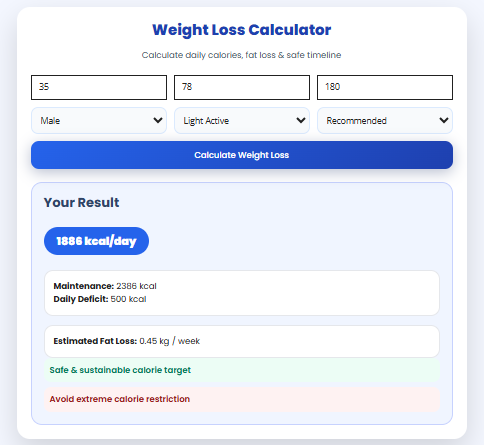
Weight Loss Calculator
Calculate daily calories, fat loss & safe timeline
Analyzing your body…
Weight Loss Calculator: How a Simple Tool Helped Me Lose Fat Without Starving or Guessing Calories
Introduction: When Weight Loss Feels Harder Than It Should Be
For years, I believed weight loss was about willpower.
Eat less.
Move more.
Repeat.
But no matter how hard I tried, the results were inconsistent. Some weeks I lost weight, other weeks I gained it back. I jumped between diets, skipped meals, followed fitness influencers, and even blamed my metabolism.
The truth was uncomfortable:
I was trying to lose weight without understanding how my body actually works.
Everything changed when I used a Weight Loss Calculator for the first time.
Not a random diet chart.
Not a motivational quote.
A calculator that showed me real numbers.
The Biggest Weight Loss Problem Nobody Talks About: Guessing
Most people don’t fail at weight loss because they’re lazy.
They fail because they’re guessing.
Common questions everyone asks:
-
How many calories should I eat?
-
How fast should I lose weight?
-
Is my diet too aggressive?
-
Am I losing fat or muscle?
Without answers, people either:
-
Eat too little and burn out
-
Eat too much and see no results
-
Lose weight unsustainably and regain it
A Weight Loss Calculator removes guesswork and replaces it with clarity.
What Is a Weight Loss Calculator?
A Weight Loss Calculator is an online tool that estimates:
-
Your daily calorie needs
-
A safe calorie deficit
-
Expected weekly fat loss
-
A realistic weight-loss timeline
It uses:
-
Age
-
Height
-
Weight
-
Gender
-
Activity level
-
Desired speed of weight loss
Instead of emotional decisions, it gives you data-driven guidance.
My Turning Point: Why I Finally Tried a Calculator
I used to think calculators were “too technical.”
But one evening, frustrated and tired of restarting diets, I entered my details into a Weight Loss Calculator.
The result shocked me.
👉 I was eating more calories than my body needed, even on “diet days.”
No wonder nothing worked.
That moment taught me a powerful lesson:
Weight loss isn’t about eating less — it’s about eating right.
How a Weight Loss Calculator Works (Simple Explanation)
The calculator uses science-based formulas to estimate:
1. Basal Metabolic Rate (BMR)
This is how many calories your body burns at rest.
2. Maintenance Calories
Calories needed to maintain current weight based on activity.
3. Calorie Deficit
A controlled reduction (usually 300–700 kcal/day).
4. Fat Loss Estimation
Since ~7700 calories ≈ 1 kg of fat, the calculator estimates weekly loss.
This approach is safe, sustainable, and realistic.
Why Most Diets Fail Without a Calculator
Here’s what happens without proper calculation:
-
People cut calories too aggressively
-
Hormones get affected
-
Muscle loss increases
-
Hunger becomes unbearable
-
Weight rebounds quickly
A Weight Loss Calculator prevents extremes.
It doesn’t promise miracles — it builds consistency.
Understanding Calorie Deficit Without Fear
Many people fear the word “calories.”
But calories are not enemies. They are units of energy.
The calculator helps you understand:
-
Your body needs fuel
-
Too little fuel slows progress
-
Sustainable fat loss is gradual
Once I stopped fearing calories and started managing them, weight loss became logical instead of emotional.
Weekly Weight Loss Expectations: Setting Realistic Goals
One of the most powerful features of a Weight Loss Calculator is expectation management.
Instead of promising “lose 10 kg in 10 days,” it shows:
-
Expected weekly fat loss
-
Why slow progress is healthier
-
How consistency beats speed
This prevents frustration and quitting.
Weight Loss vs Fat Loss: The Difference That Matters
Not all weight loss is fat loss.
Without proper calorie planning:
-
Muscle loss increases
-
Metabolism slows down
-
Body composition worsens
A calculator helps you:
-
Target fat loss
-
Preserve muscle
-
Maintain strength
For best results, it should be used alongside a
👉 Protein Calculator (internal backlink)
to protect lean muscle mass.
Why Activity Level Changes Everything
Two people of the same weight can have very different calorie needs.
That’s why a Weight Loss Calculator asks about:
-
Sedentary lifestyle
-
Light activity
-
Moderate exercise
-
Very active routine
Ignoring activity leads to wrong calorie targets.
This personalization is what generic diet charts miss.
How I Combined a Weight Loss Calculator With a Diet Plan
Once I knew my calorie target, planning meals became easier.
I paired the calculator with a
👉 AI Diet Calculator (internal backlink)
to build weekly meals around my calorie limit.
Result:
-
No starvation
-
No guilt
-
No confusion
Just structure.
Psychological Benefits: Less Stress, More Control
The biggest change wasn’t physical — it was mental.
-
I stopped second-guessing meals
-
I stopped chasing quick fixes
-
I trusted the process
A Weight Loss Calculator gave me control, not restriction.
Why Weight Loss Calculators Are Better Than Diet Trends
Diet trends come and go.
Calculators stay relevant because:
-
Bodies follow biology, not trends
-
Numbers don’t lie
-
Personalization beats popularity
This is why calculators consistently outperform static articles.
Who Should Use a Weight Loss Calculator?
This tool is ideal for:
-
Beginners starting weight loss
-
Busy professionals
-
Home workout followers
-
People tired of yo-yo dieting
-
Health and fitness websites
-
Adsense-based calculator platforms
SEO & Monetization Advantage for Websites
From a website owner’s perspective, calculators:
-
Increase time on page
-
Reduce bounce rate
-
Encourage repeat visits
-
Support affiliate offers
-
Improve Adsense RPM
They’re not just content — they’re interactive assets.
Common Weight Loss Mistakes a Calculator Helps Avoid
-
Eating too little
-
Losing muscle instead of fat
-
Unrealistic expectations
-
Random dieting
-
Overtraining
A Weight Loss Calculator acts like a guardrail.
15 Frequently Asked Questions (FAQs)
1. What is a Weight Loss Calculator?
A tool that estimates calorie needs and fat loss based on personal data.
2. Is a Weight Loss Calculator accurate?
It provides reliable estimates based on established formulas.
3. Can beginners use it?
Yes, it’s designed for beginners.
4. Is rapid weight loss safe?
Aggressive deficits are not recommended long-term.
5. Does it work for women?
Yes, it accounts for gender differences.
6. Can I use it daily?
Yes, especially if weight or activity changes.
7. Does it replace a nutritionist?
No, it’s a guidance tool, not medical advice.
8. Will it help with belly fat?
It supports overall fat loss, not spot reduction.
9. Does activity level matter?
Yes, it significantly impacts calorie needs.
10. Is calorie counting necessary?
Understanding calories improves consistency.
11. Can I lose weight without exercise?
Yes, but exercise improves results.
12. Does it support sustainable weight loss?
Yes, it focuses on safe deficits.
13. Can I combine it with a protein calculator?
Yes, that’s recommended.
14. Is it free to use?
Yes, most online calculators are free.
15. Who should avoid using it?
People with medical conditions should consult a professional.
Final Conclusion: Why a Weight Loss Calculator Changes Everything
Most people don’t need another diet.
They need clarity.
A Weight Loss Calculator gives you:
-
Direction instead of confusion
-
Structure instead of stress
-
Data instead of guesses
When combined with tools like a Protein Calculator and a Diet Planner, it becomes a complete system — not a shortcut.
👉 If you’re serious about losing weight, stop guessing.
👉 Calculate your needs.
👉 Follow a sustainable plan.
Progress becomes predictable when decisions are informed.
Disclaimer
This Weight Loss Calculator is for educational and general informational purposes only.
It is not intended to diagnose, treat, cure, or prevent any medical condition.
Individuals with medical issues, eating disorders, pregnancy, or chronic illnesses should consult a qualified healthcare professional before making dietary or lifestyle changes.
Facebook
Twitter
LinkedIn
Facebook
WhatsApp
Telegram